






















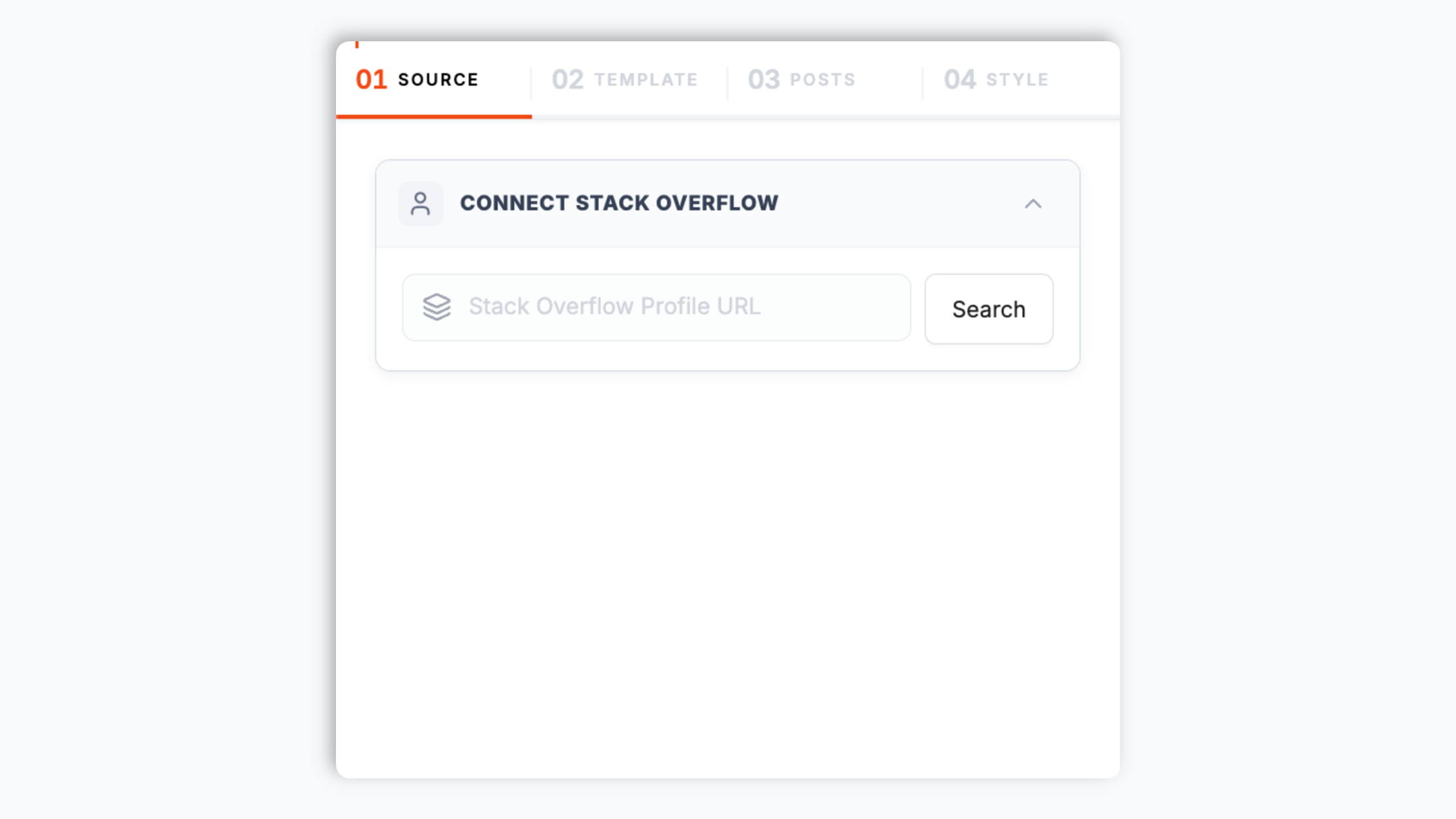
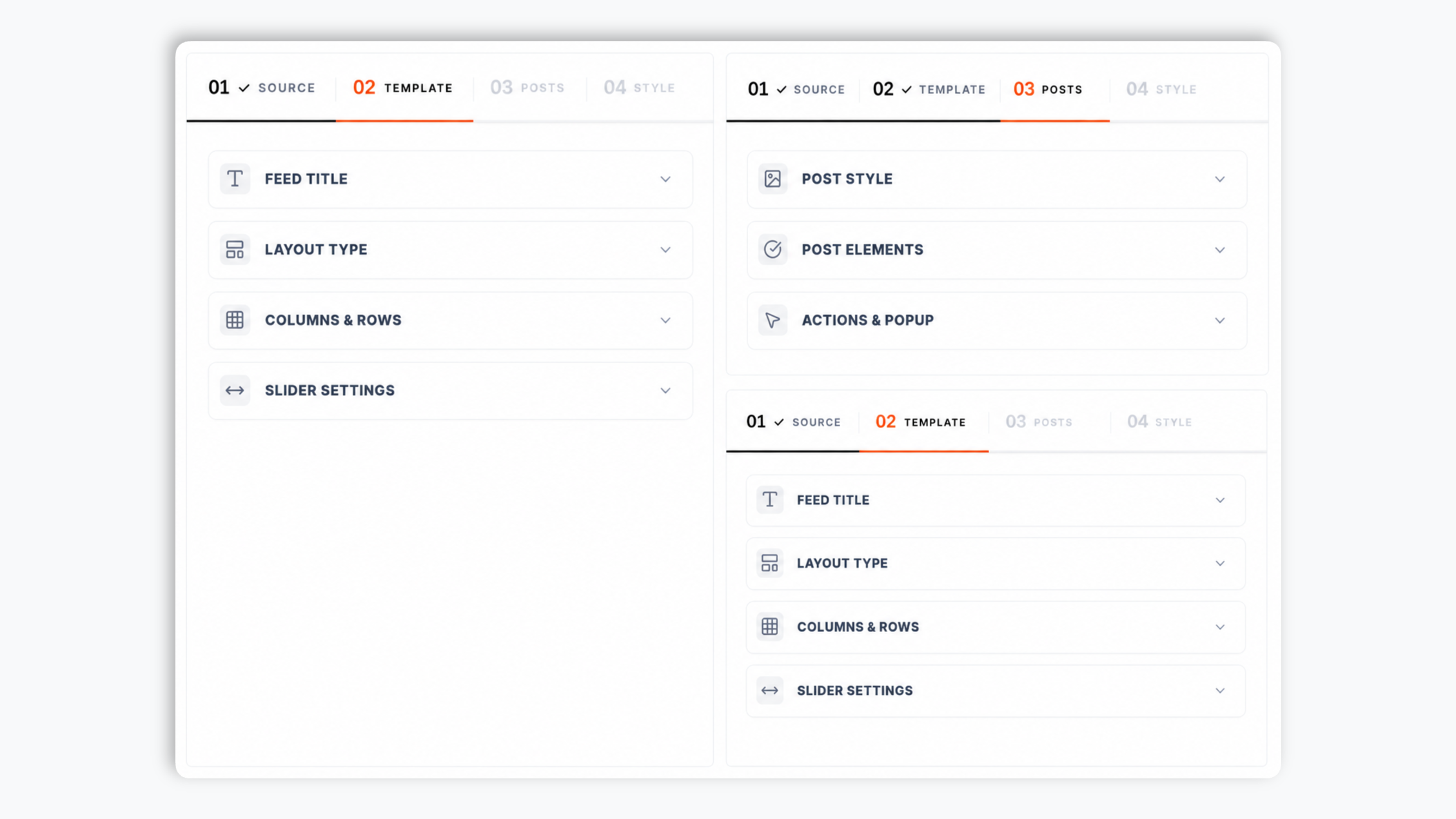
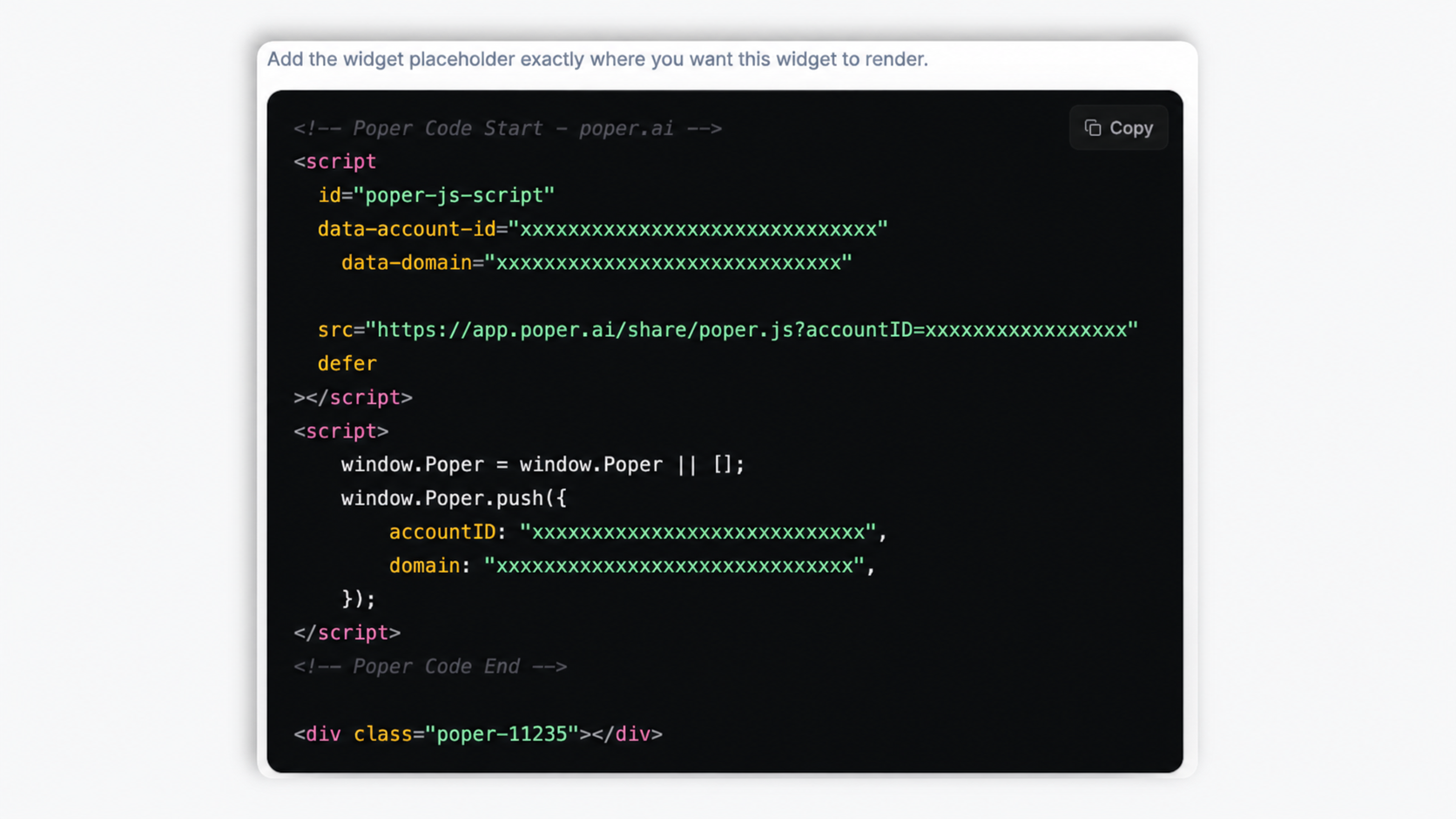
Three steps. Under two minutes. Public profiles work with no API key.
01Step 1
Paste your Stack Overflow profile URL
Drop in stackoverflow.com/users/123456/your-handle. Poper instantly previews your reputation, top tags, gold/silver/bronze badges, and most up-voted answers.
02Step 2
Pick a layout and brand it
Choose Reputation Card, Top Answers, Tag Reputation Grid, Badge Strip, Accepted Answer List, or Activity Stream. Filter by tag, theme colors and fonts, and tune how much detail surfaces on each card.
03Step 3
Copy the snippet and embed
Paste the one-line script tag into your portfolio, consulting page, conference talk page, or engineering team page. Works on Next.js, Astro, Hugo, Webflow, Framer, WordPress, Ghost, and any HTML stack.
Works everywhere
Works with every website platform you already use
Drop-in install on WordPress, Shopify, Wix, Squarespace, Webflow, Framer, Ghost, and any HTML-friendly stack. No build step, no developer needed.
WordPress
Shopify
Wix
Squarespace
Webflow
Framer
Ghost
HTML
Plus 250+ other platforms via the embed snippet. If your site can render a <script> tag, it can render the Stack Overflow Feed Widget: Embed Reputation, Badges, Top Tags and Answers.
What you get with Poper Stack Overflow Feed
Six things that matter when you embed Stack Overflow on a developer portfolio, not 30 features no one uses.
Live reputation, badges, and top answers
Pulls from the Stack Exchange API v2.3 with endpoints for /users, /users/{ids}/answers, /users/{ids}/badges, and /users/{ids}/tags. Reputation, tag breakdown, gold/silver/bronze badge counts, and top-voted answers all flow into a single themable block that updates on its own. No backend, no scraping, no late-night copy edits when you earn a new badge.
Tag reputation grid
Show off the tags you actually own. Render a grid of your top 5, 10, or 20 tags with reputation per tag, post counts, and gold-tag highlights. The strongest signal of real expertise on a consulting or hire-me page.
Gold, silver, bronze badge strip
Mirror your full badge wall with tier counts and earned dates, or filter to gold-only for a cleaner consulting page.
Top answers card deck
Surface your highest-scored or accepted answers across all of Stack Overflow, or filter to a single tag like [postgresql] or [kubernetes].
Lighthouse-safe and Core Web Vitals friendly
Lazy-loaded below the fold, async-injected, scoped CSS that does not bleed into your portfolio's design system. Under 40KB gzipped. Zero CLS, zero LCP regression. Perfect score on dev portfolio Lighthouse audits, which your audience will absolutely run.
Whole Stack Exchange network
Stack Overflow is just one of 170+ Stack Exchange sites. The widget supports Server Fault, Super User, Cross Validated, Ask Ubuntu, Mathematics, and the rest. Combine reputation across sites for full multi-site cred.
Use cases
Where Stack Overflow Feed Widget: Embed Reputation, Badges, Top Tags and Answers actually moves the needle
Four buyer types who get the most lift from embedding Stack Overflow Feed Widget: Embed Reputation, Badges, Top Tags and Answers on their site.
Senior developers showcasing reputation
Turn a 50k+ Stack Overflow reputation into a live proof-of-expertise block on your personal site. Recruiters and clients see exactly the tags you own and the answers that earned them, not a static line in a bio. The single most credible signal of deep, verified engineering knowledge.
Tech recruiters showcasing portfolios
Embed your candidates' Stack Overflow reputation on agency or boutique-recruiter pages. Show top answers and tag reputation as live proof your roster has the depth you sell. Wins trust from hiring managers in seconds.
Bootcamp grads building public proof
New grads use the widget to surface their early answers, accepted answers, and growing tag reputation on a personal portfolio. A 1k-rep dev with five accepted answers in [react] reads as more credible than a polished resume bullet ever can.
Technical writers and dev advocates
Tech writers, DevRel engineers, and conference speakers embed top answers filtered to their topic. Pair a Kafka talk page with a live top answers on [apache-kafka] block, and your program committee sees instant credibility on the abstract.
Poper vs other Stack Overflow widgets
Most ways to show Stack Overflow on your site are static SVG flair, the legacy native flair embed, or scraping HTML. Here is how the popular options compare on what actually matters for a dev portfolio in 2026.
Recommended
Poper
Stack Overflow Native Flair
GitHub Activity Widget
Dev.to Feed Widget
Free plan available
Live reputation, badges, top answers
Reputation only
Different platform
Different platform
Tag reputation grid
Top answers card deck (filter by tag)
Themable to match your brand
Color preset only
Auto refresh without redeploy
Image refresh only
Whole Stack Exchange network support
Stack Overflow only
Multi-user or aggregated team feed
Schema.org Person and CreativeWork JSON-LD
Edge-cached responses (no rate-limit risk)
Hotlinked image
Pricing for unlimited refreshes
$19/mo (Pro)
Free image
$19/mo (Pro)
$19/mo (Pro)
Bundled with popups, forms, quizzes
Comparison reflects publicly available features as of 2026. Stack Overflow's native flair embed (the legacy stackoverflow.com/users/flair script) is free and lightweight but limited to a static reputation badge with no tag grid, no top answers, and no theming beyond a fixed color preset.
Real consultants. Real portfolios.
Senior devs, consultants, and engineering teams who replaced static flair badges with Poper.
“Poper has improved our website's user engagement! Since integrating Poper's personalized popups, we've seen a dramatic surge in conversions and user interactions. The platform's intuitive design makes creating and customizing popups a breeze, even for those with minimal tech skills. What truly sets Poper apart are its…”
“Fantastic app and support team, they are very quick to help and provide a solution or improvement to their product. Highly recommended!”
Alex
CEO · AH
“Poper has been a total lifesaver for our agency! As a digital marketing agency, we’re always juggling a million things at once. Poper has been a real game-changer in terms of streamlining our workflow and keeping track of all our clients’ campaigns. The ability to track all our clients’ websites from one place is a…”
Idris Basir
-
Pricing
Simple pricing. Free plan covers most websites.
Free forever for one widget. Upgrade only when you need faster sync, multiple instances, or to drop the watermark.
All plans include unlimited page views, no contracts, cancel anytime. Annual billing saves 20%.
Guide · 5 min read
The complete guide to embedding Stack Overflow on your website
Stack Overflow remains the dominant developer Q&A site even after a decade of new entrants. Founded in 2008 by Joel Spolsky and Jeff Atwood, acquired by South African investment giant Prosus in 2021 for $1.8 billion, and challenged by ChatGPT after 2022, the site still hosts more than 24 million programming questions and 35 million answers. For senior engineers, consultants, technical writers, and dev advocates, a Stack Overflow reputation is one of the few publicly verifiable proofs of deep, hard-earned expertise. Embedding that reputation directly on a personal site or consulting page turns a number on stackoverflow.com into a live trust signal on your own domain. This guide covers what actually matters in 2026: the Stack Exchange API v2.3 quotas, the reputation and badge system, the tag economy, the Prosus era, the OverflowAI launch, the post-ChatGPT traffic decline, and how to choose a stack overflow feed widget that survives rate limits and stays Lighthouse-clean.
01
Stack Exchange API v2.3: quotas, keys, and the daily request budget
The Stack Exchange API v2.3 is the official, documented JSON API behind every Stack Exchange site, including Stack Overflow itself. Public read endpoints (/users, /users/{ids}/answers, /users/{ids}/badges, /users/{ids}/tags, /users/{ids}/top-tags, /questions, /search) work with no key, rate-limited to 10,000 requests per IP address per day. Registering a free application key on stackapps.com lifts the daily quota to 100,000 requests and lets you authenticate users via OAuth 2.0 for write actions like posting answers or voting. For a widget showing public reputation and top answers, no key is technically needed, but Poper registers an application key and proxies every call through a global edge cache so your visitors never hit api.stackexchange.com directly. The cache hit rate sits above 98% in practice, which means even a portfolio at the top of Hacker News will not exhaust the daily quota or render an empty card. The API exposes the entire Stack Exchange network through a single host, so the same widget works on Server Fault, Super User, Cross Validated, Ask Ubuntu, Mathematics, and the other 170+ sites with a one-character site parameter change.
02
The reputation system: economics of trust on the open dev web
Stack Overflow's reputation system, designed by Jeff Atwood in 2008, is the longest-running game-theory experiment on the open developer web. Reputation is earned exclusively through up-voted answers, accepted answers, and edits, capped at 200 reputation per day to keep the curve honest. A 10k reputation dev has typically answered hundreds of questions and is empowered to moderate (vote-to-close, edit anyone's posts, view deleted posts). A 50k+ rep dev is exceptionally rare: roughly the top 0.5% of all account holders. Crucially, reputation is per-site, and tag reputation (the slice of reputation earned in a specific tag like [postgresql]) is the strongest publicly verifiable signal of niche expertise on the entire web. A consultant with 30k tag rep in [kubernetes] has been the trusted answer-author on Kubernetes questions for years, something no certification, blog post, or conference talk replicates. Embedding tag reputation on a hire-me page turns this otherwise hidden number into the headline trust signal your visitors actually need.
03
Prosus, OverflowAI, and the AI-training controversy of 2024
In 2021 South African investment conglomerate Prosus acquired Stack Overflow for $1.8 billion, the largest known acquisition in developer-tools history at the time. The site stayed editorially independent and the API stayed open. In 2023 Stack Overflow announced OverflowAI, a suite of AI features integrated into the search and answer flow, partnered with Google Cloud and OpenAI for training data. The same year, in a separately announced deal, Stack Overflow began licensing user-generated content to LLM providers including OpenAI for model training. The community pushback was significant: many high-reputation users protested by editing or removing their answers, the moderators issued open letters, and the company eventually clarified data licensing controls and opt-out mechanics. Through all of this the public read API remained open and free, the reputation system unchanged, and the underlying knowledge base still the most-cited answer source on the open web. For widget builders the practical takeaway is simple: the Stack Exchange API v2.3 is stable, the data model has not changed since 2014, and a widget shipped today will keep working through whatever ownership or AI-product change ships next.
04
Post-ChatGPT traffic decline and why on-site embeds matter more, not less
Stack Overflow traffic declined notably after ChatGPT launched in November 2022, with multiple analyses showing question-volume drops in 2023 and 2024 as developers turned to LLMs for first-pass answers. The site response was a doubling-down on community quality and the OverflowAI integration. For developers showcasing expertise, the practical implication has not gone the direction critics predicted: the answers that remain on Stack Overflow are still the canonical reference indexed by every search engine, still the top result on Google for the long-tail technical query, and still the source LLMs (including ChatGPT) cite back to. A high tag reputation in 2026 is in some ways more valuable than in 2018 because the bar to earn one is higher. Embedding that reputation on your own site means your trust signal lives where your audience already is (your portfolio, your hire-me page, your conference talk landing page) instead of being one click away on stackoverflow.com where they might never go. On-site embeds also keep the SEO benefit on your domain instead of donating it to stackoverflow.com.
05
Stack Overflow vs Dev.to: reputation systems vs community channels
Stack Overflow and Dev.to are often grouped as developer platforms but they serve completely different positioning needs. Stack Overflow is a Q&A reputation graph: every contribution is graded by community vote, every reputation point is hard-earned, and the site cares only about whether your answer is correct. Dev.to (built on the open-source Forem platform) is a community channel: every author chooses what to publish, posts are surfaced by reactions and tag follows, and the site cares about distribution and conversation. For a developer portfolio, the two complement each other: Dev.to shows what you teach and write about, Stack Overflow shows what you have proven in adversarial peer review. Embedding both side-by-side on a single portfolio page is the strongest possible developer credibility stack. This is why Poper ships sister widgets for Dev.to, Hashnode, GitHub Activity, and GitLab Activity Feed under the same v2 spec. Senior engineers and consultants typically embed three of the four on their personal sites: Stack Overflow for proof, GitHub for shipping cadence, and Dev.to or Hashnode for teaching voice.
Quick reference
What is Stack Overflow Feed Widget: Embed Reputation, Badges, Top Tags and Answers?
A Stack Overflow feed widget is an embeddable script that displays a developer's Stack Overflow profile (reputation, gold/silver/bronze badges, top tags, accepted answers, and most up-voted answers) on any website. It pulls live data from the Stack Exchange API v2.3, themes it to match the host site, and refreshes automatically.
Key facts
1Stack Overflow was founded in 2008 by Joel Spolsky and Jeff Atwood and remains the dominant developer Q&A site with more than 24 million programming questions and 35 million answers
2The Stack Exchange network includes 170+ sister Q&A sites covering Server Fault, Super User, Cross Validated, Ask Ubuntu, Mathematics, and many other technical domains
3Stack Overflow was acquired by South African investment giant Prosus in 2021 for $1.8 billion, the largest known developer-tools acquisition at the time
4Public Stack Overflow data is freely accessible via the Stack Exchange API v2.3 with no key, rate-limited to 10,000 requests per IP per day, or 100,000 with a free application key
5Reputation is earned exclusively through up-voted answers, accepted answers, and edits, capped at 200 reputation per day to preserve the integrity of the long-term curve
6Tag reputation is per-tag and is widely considered the strongest publicly verifiable signal of niche engineering expertise on the open web in 2026
Frequently asked questions
Can't find the answer you're looking for? Chat with our support team.
No. The Stack Exchange API v2.3 unauthenticated rate limit is 10,000 requests per IP per day, and an authenticated request limit (with a free application key registered on stackapps.com) is 100,000 per day. Poper registers an application key, proxies every call through a global edge cache, and the cache hit rate sits above 98% in practice. Your visitors never hit api.stackexchange.com directly. Your widget makes one origin request every 6 hours (Free) or 30 minutes (Pro), regardless of how many people visit your site, so even a portfolio at the top of Hacker News will not exhaust the quota or render an empty card.
Yes. The widget supports a multi-block layout that combines a Reputation Card (current rep, daily change, accepted answer count), a Tag Reputation Grid (your top 5 to 20 tags with rep per tag and gold-tag highlights), and a Badge Strip (gold/silver/bronze counts with earned dates). You can also add a Top Answers card deck filtered to your strongest tag, or an Activity Stream showing recent answers and questions. Each block has independent layout and theming controls so you can mix-and-match the proof signals that fit your page type, whether that is a consulting hire-me page, a conference speaker page, or an engineering team page.
Yes, this is the most-used filter on consulting and conference-speaker pages. Add a tag filter in the widget builder (or pass tags=postgresql in the embed config) and the widget shows only your reputation, badges, and top answers within that tag. You can filter to a single tag, multiple tags joined with OR, or aggregate multiple tags into one combined credibility block. Tag filtering uses the Stack Exchange API v2.3 /users/{ids}/answers endpoint with a tagged parameter, and works across the entire Stack Exchange network so you can also filter Server Fault, Super User, or Cross Validated profiles.
Yes. The widget supports three modes: User mode pulls a single profile (great for personal portfolios), Multi-user mode aggregates 2 to 50 users into one combined reputation block (great for engineering team pages, consulting agencies, and bootcamp instructor pages), and Site mode aggregates an entire Stack Exchange site with optional tag filter (great for community pages). Multi-user mode pulls from the /users/{ids} endpoint with up to 100 user IDs per request, then sums and ranks. Use it on a /engineering page to surface the combined SO presence of your senior team, which is one of the strongest organic signals to candidates that the company values knowledge-sharing.
Yes. The Poper Stack Overflow Feed Widget emits Person schema.org JSON-LD for the underlying user (name, URL, sameAs link to stackoverflow.com), CreativeWork schema for each surfaced answer with author, datePublished, and url fields, and Award schema for each badge tier. Search engines like Google can pick up these signals and use them in rich results for queries like your name plus stack overflow or your handle plus the tag you specialize in. The widget also exposes a reputation count and badge counts as plain HTML on the page, which means the numbers are indexable text on your domain rather than locked inside a remote embed.
No. The widget is engineered to be Lighthouse-safe specifically because the audience for a developer portfolio is technical and will run audits. The script is async-loaded below the fold, gzipped under 40KB, uses scoped CSS that does not bleed into your design system, reserves dimensions on every element to keep CLS at zero, and proxies all Stack Exchange API calls through a global edge cache so visitors never make blocking requests to api.stackexchange.com. We routinely test on Next.js, Astro, and Hugo portfolios and the widget does not move the Performance, Accessibility, Best Practices, or SEO score from a 95+ baseline.
On the Free plan, Poper polls the Stack Exchange API v2.3 every 6 hours, so a new accepted answer is on your widget by lunch. On Pro and Business plans, polling drops to every 30 minutes, which is fast enough that the widget feels nearly real-time after a noteworthy answer or a new badge. You can also force a manual refresh from the Poper dashboard, which is useful right after earning a gold tag or a badge you want to show off immediately. Behind the scenes Poper uses the API's last_activity_date and creation_date fields to detect changes efficiently and only counts against your quota when the underlying data actually changed.
Yes, and arguably more relevant for proof-of-expertise specifically. After Prosus acquired Stack Overflow in 2021 for $1.8 billion, the public read API stayed open and free, the reputation system unchanged. The 2023 OverflowAI launch and the AI-training data licensing deals drew significant community pushback (some high-rep users edited or removed answers in protest), but the underlying knowledge base remains the canonical reference indexed by every search engine and cited by every LLM, including ChatGPT itself. Question volume is lower than 2022 because LLMs handle the easy lookups, but that means a high tag reputation earned in 2025 or 2026 is harder-won and more credible than ever. For a senior dev or consultant, embedding that rep on your own site is the strongest publicly verifiable trust signal available on the open web.
Pair it with the rest of Poper
Embed the rest of your developer presence with sister widgets across other dev platforms.