Ghost Feed Widget for Website. Free, API-Synced - Poper
Ghost Feed Widget

Ghost on any website.

Embed your Ghost(Pro) or self-hosted publication in 90 seconds. Posts, tags, newsletters, and paid member previews via the official Content API. Free, no code.

No credit card required
14-day free trial
Cancel anytime
Ghost feed widget shown on iPhone, iPad, and Macbook with publication posts, tag filters, and a paid member preview block

Trusted by 11,000+ brands

Timetics
Academie Digitale
Goldcast
nbcf
Seedstock
Wow
Linkxar
Gale Toyota
Skills
Rugby Sport
Lamp
Leaktronics
Steel
Theatre in Chicago
Globerto
Meetup
FYM
Zeben
Kraftix
IETraditionala
Meethires
Leadscrape
Happily
Timetics
Academie Digitale
Goldcast
nbcf
Seedstock
Wow
Linkxar
Gale Toyota
Skills
Rugby Sport
Lamp
Leaktronics
Steel
Theatre in Chicago
Globerto
Meetup
FYM
Zeben
Kraftix
IETraditionala
Meethires
Leadscrape
Happily
Free forever, paid plans from $19/mo

Customer wall

Trusted by 11,000+ brands shipping Ghost Feed Widget: Embed Posts, Newsletters and Paid Memberships on Any Site today

From DTC stores and SaaS companies to local clinics and global agencies.

Plus 10,000+ more across 130 countries.

Try the live widget

Live demo, not a screenshot. Drop in a Ghost URL and Content API key, pick a layout, embed. What you see here is what ships to your site.

Walkthrough

How the Ghost Feed widget works in 60 seconds

A short walkthrough: connect, customize, embed. End-to-end from blank account to live widget.

Watch a 60-second walkthrough of pasting your Ghost URL, dropping in your Content API key, and embedding the snippet on any site.

Want a deeper dive? Read the full setup guide below or jump straight into the live builder.

From Ghost to your site

Your Ghost reviews. Now on your own domain.

Poper crawls the official Ghost review feed for your business and renders it inline on your website. Same reviews, your branding, your domain.

ghost.org
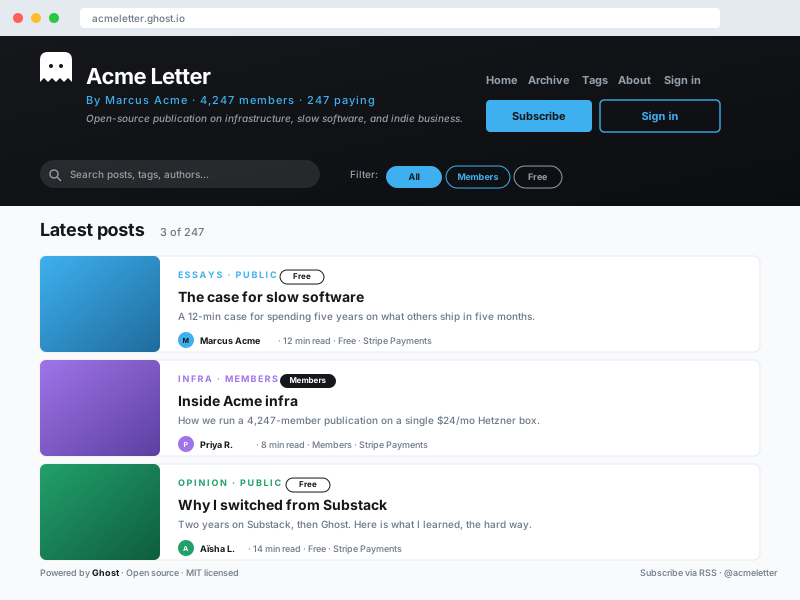
Ghost publication acmeletter.ghost.io showing the Acme Letter dark navy header by Marcus Acme with 4,247 members and 247 paying, plus three post cards with member-only and free badges and read-time bylinesSource: GhostOpen
Ghost publication acmeletter.ghost.io showing the Acme Letter dark navy header by Marcus Acme with 4,247 members and 247 paying, plus three post cards with member-only and free badges and read-time bylines
marcusacme.com
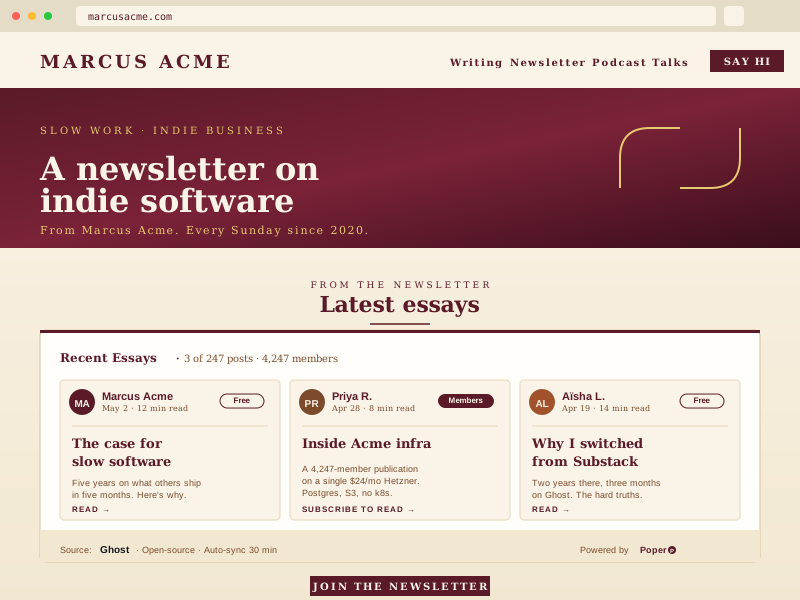
Marcus Acme's own marcusacme.com site in deep-burgundy and warm-cream with the Poper Ghost feed widget embedded inline showing the same three posts and a Source Ghost auto-sync footerPoper widget live
Marcus Acme's own marcusacme.com site in deep-burgundy and warm-cream with the Poper Ghost feed widget embedded inline showing the same three posts and a Source Ghost auto-sync footer

Mockups for illustration. Pull your real Ghost Feed Widget: Embed Posts, Newsletters and Paid Memberships on Any Site from Ghost and embed in 90 seconds.

How to use it

How to add Ghost to your website

Three steps. Under two minutes. No developer needed.

  1. 01

    Paste your Ghost URL and Content API key

    Drop in your Ghost(Pro) URL or self-hosted Ghost domain. Generate a read-only Content API key under Settings, Integrations and paste it. Poper validates the connection in seconds.
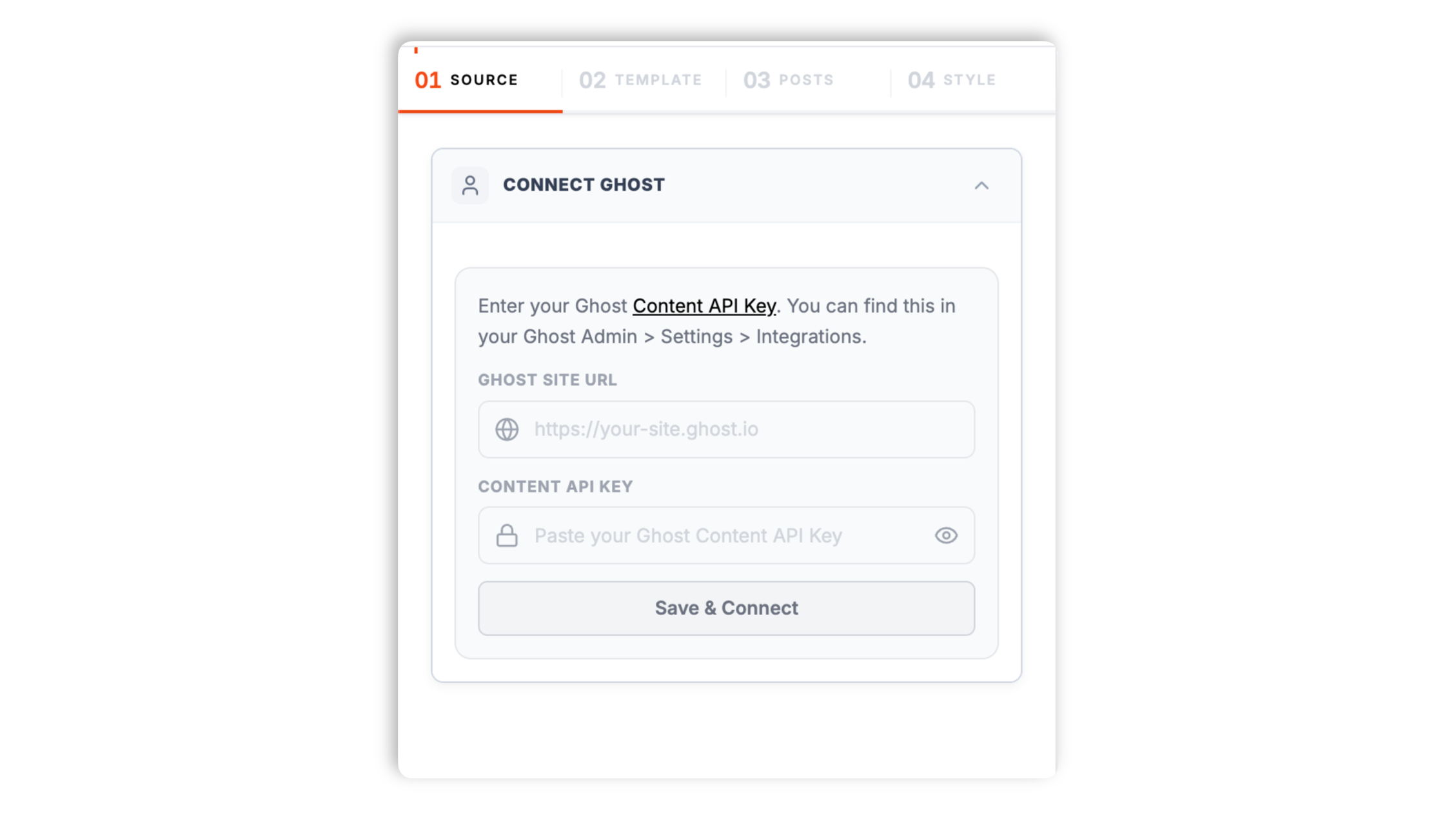
    Poper widget builder connecting to Acme Letter at acmeletter.ghost.io with 4,247 members, Pro badge, and dark navy Connect button
  2. 02

    Pick a layout, filter by tag or newsletter, brand it

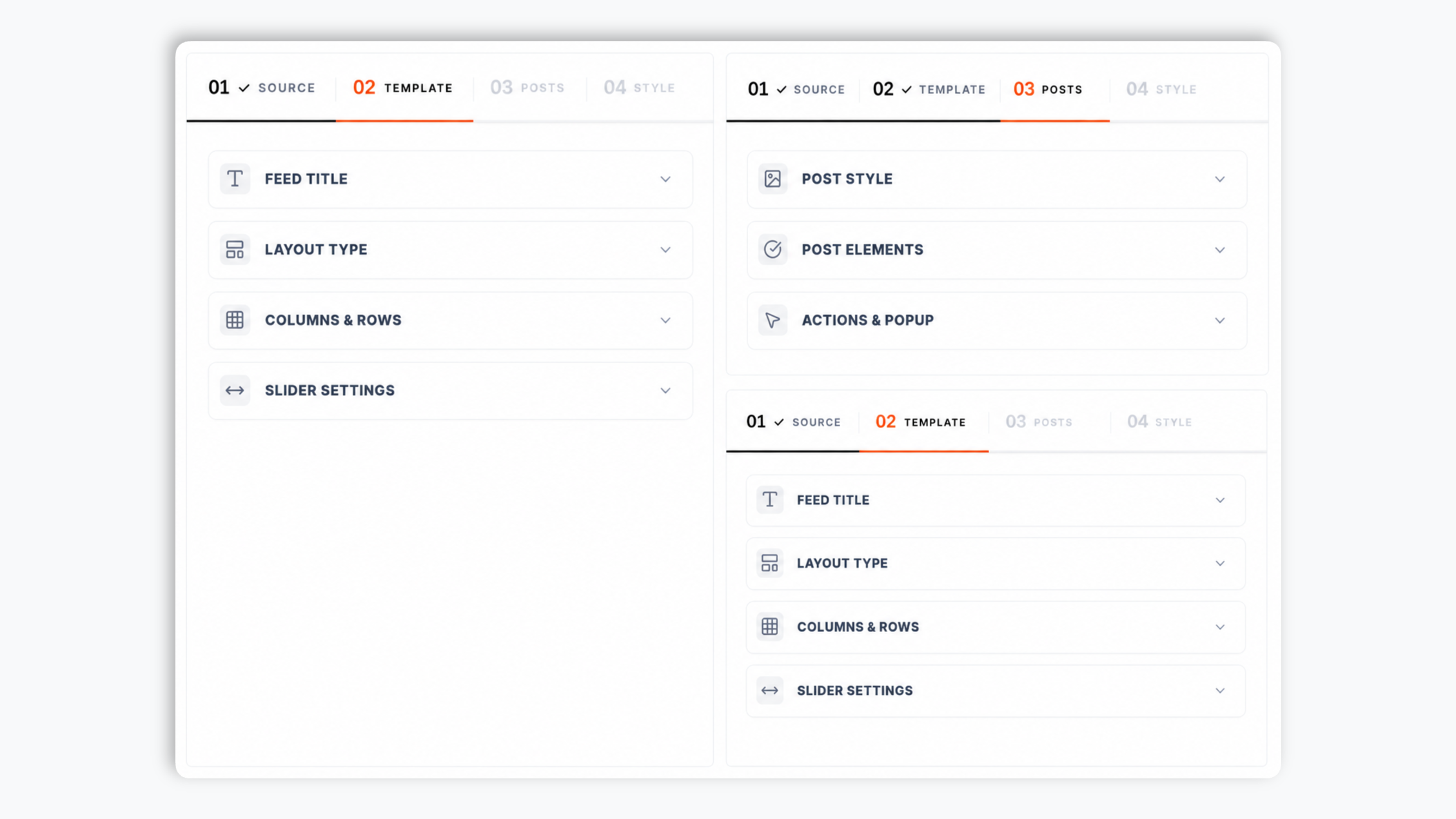
    Choose Magazine, Article List, Card Grid, Featured + Recent, Tag Wall, or Per-Newsletter. Filter by tag, author, or newsletter slug. Tune typography, accent color, and member preview styling.

    Six Ghost layout thumbnails (Magazine, Article List, Featured + Recent, Card Grid, Newsletter, Tag Wall) with member-only and free badges plus brand color and badge style controls
  3. 03

    Copy the snippet and embed

    Paste the one-line script tag into any site. Works on Webflow, Framer, Carrd, Notion-Site, Hugo, Ghost itself, and 250+ platforms.
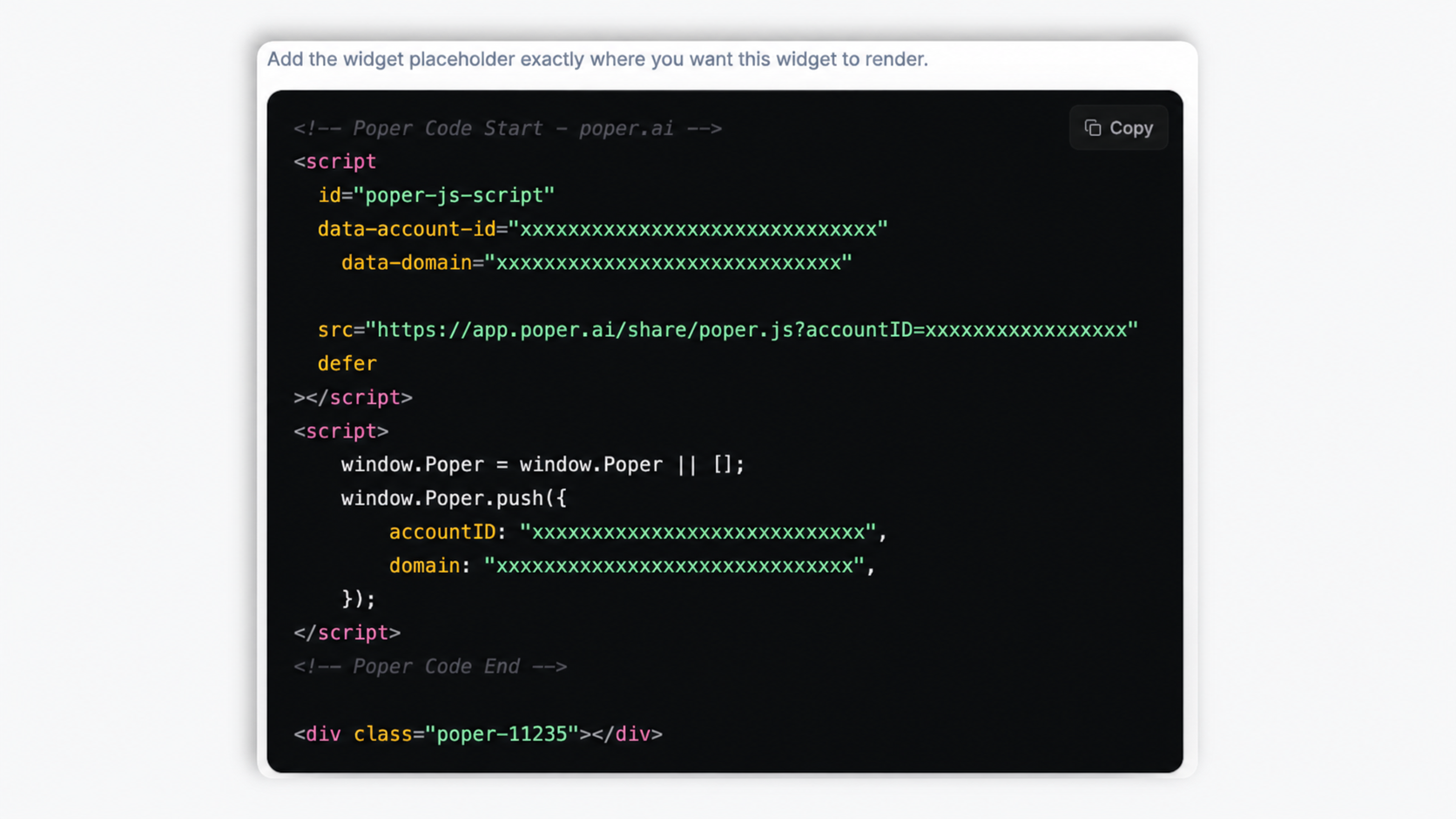
    Two-line embed snippet copied to clipboard with dark Copy button, plus Webflow, Framer, Carrd, Notion-Site, and Hugo platform cards

Works everywhere

Works with every website platform you already use

Drop-in install on WordPress, Shopify, Wix, Squarespace, Webflow, Framer, Ghost, and any HTML-friendly stack. No build step, no developer needed.

WordPress
Shopify
Wix
Squarespace
Webflow
Framer
Ghost
HTML

Plus 250+ other platforms via the embed snippet. If your site can render a <script> tag, it can render the Ghost Feed Widget: Embed Posts, Newsletters and Paid Memberships on Any Site.

What you get with Poper Ghost Feed

Six things that matter when you are paying for a Ghost widget, not 30 features no one uses.

Pulled live from the Ghost Content API

Ghost ships an official, documented Content API in every release since Ghost 2.x. Poper uses that API with a read-only key you generate yourself, which means no scraping, no fragile workarounds, and no risk of breakage when Ghost ships a new version. Ghost 5.x, Ghost(Pro) hosted, and self-hosted installs all work identically because the API contract is stable across all of them.

Native member previews and paid tiers

Ghost has memberships and paid subscriptions built in since Ghost 4.0. Public posts render in full inside the widget. Member-only and paid-tier posts surface a clean preview with a Subscribe to read CTA wired straight to your Ghost member signup. Your paywall stays inside Ghost, your free-to-paid funnel runs from your own domain.

Filter by tag, author, or newsletter

Ghost supports multiple newsletters per publication, internal tags, and author profiles. Point the widget at #longform to build an essays-only block, at a single newsletter slug for an issue-only feed, or at one author for a contributor portfolio. No theme hacking required.

Per-newsletter targeting

Run multiple newsletters from one Ghost publication and embed each one as its own widget on its own landing page. Readers see the right issues in the right context, every time.

Multi-author publication support

Ghost is a popular CMS for B2B SaaS company blogs and multi-author magazines. The widget surfaces author avatars, names, and bios per post, and can filter by author slug for contributor pages. Built for editorial teams, not just solo bloggers.

Core Web Vitals safe

Lazy-loaded below the fold, async-injected, scoped CSS that does not bleed into your design system. Under 40KB gzipped. Content API responses are cached on a global CDN edge so visitors do not hit your Ghost origin on every page view, which keeps your Ghost server load near zero even at high traffic.

Use cases

Where Ghost Feed Widget: Embed Posts, Newsletters and Paid Memberships on Any Site actually moves the needle

Four buyer types who get the most lift from embedding Ghost Feed Widget: Embed Posts, Newsletters and Paid Memberships on Any Site on their site.

Paid newsletter scenario: laptop showing a member-only paywall card, tier-pricing breakdown from Free to Founding, and a member-count chart trending up to 4,247

Paid newsletter

Founder-led newsletter publishers running paid memberships on Ghost for the 0 percent revenue share. Embed paid post previews on your public homepage with a Subscribe CTA wired straight to your Ghost member signup, keeping Stripe billing inside Ghost while the marketing site drives acquisition.

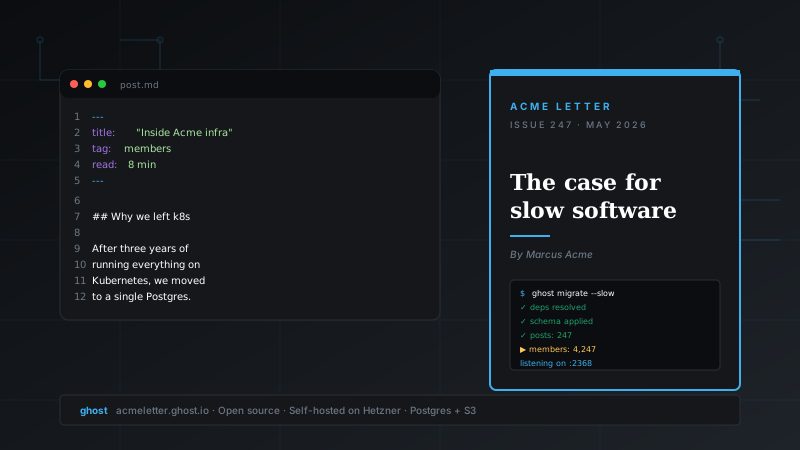
Tech publication scenario: code editor with post.md frontmatter on the left, magazine cover for Issue 247 of Acme Letter on the right, technical illustration backdrop

Tech publication

B2B SaaS company blogs and developer-tool teams that migrated from WordPress to Ghost for the multi-author support and clean Markdown editor. Surface your engineering posts and product updates on landing pages and partner sites without replicating your Ghost theme.
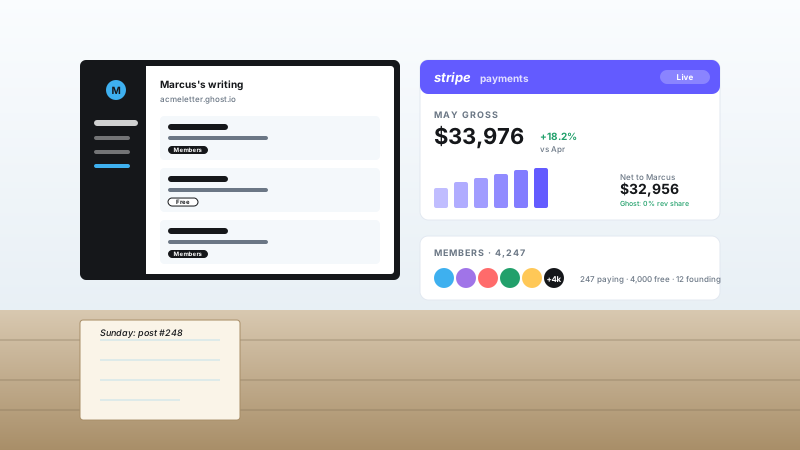
Creator business scenario: indie publisher's monitor showing the Ghost editor, a Stripe Payments dashboard with $33,976 May gross at 0 percent revenue share, and a 4,247-member directory

Creator business

Independent journalists and indie publishers running their entire writing business on Ghost. Stripe payments handle paid members, the Ghost member directory holds the audience relationship, and an embedded feed on your main site converts public visitors into paid Ghost members from your own domain.

Podcast plus newsletter scenario: two studio microphones flanking an episode card with waveform for Ep 47 Slow software is good software, and a Join the Newsletter email signup form

Podcast + newsletter

Independent podcasters running a companion newsletter on Ghost so the audience relationship lives in their own member database, not on Apple Podcasts or Spotify. Embed the latest episode plus newsletter signup on your podcast homepage, and convert listeners into members on your own domain.

Poper vs other Ghost embed options

Ghost ships native portal and signup widgets but no posts feed embed. WordPress feed widgets and Substack feed widgets solve adjacent jobs poorly. Here is how the popular options stack up.

 Recommended
Poper
Ghost native widgets
WP-feed widget
Substack-feed widget
Free plan available
Limited
Embed Ghost posts feed on third-party site
Filter by Ghost tag
Theme only
Per-newsletter targeting
Multi-author byline support
Theme only
Limited
Member-only paid preview handling
Ghost site only
Different platform
Sync frequency (lowest plan)
1 hour
Live on Ghost site
12 hours
1 hour
Custom CSS / total design control
Theme edit only
Paid only
Paid only
Works on Ghost(Pro) and self-hosted
N/A
N/A
Pricing for unlimited posts
$19/mo (Starter)
Free with Ghost
$15/mo
$19/mo
Bundled with popups, forms, quizzes

Comparison reflects publicly listed pricing and features as of 2026. Verify current details on each provider's site.

Real publishers. Real outcomes.

Independent journalists, B2B SaaS content teams, paid-membership magazines, and multi-author publications who put their Ghost publication on every site they own.

Poper has improved our website's user engagement! Since integrating Poper's personalized popups, we've seen a dramatic surge in conversions and user interactions. The platform's intuitive design makes creating and customizing popups a breeze, even for those with minimal tech skills. What truly sets Poper apart are its…
Jayson Ang
Jayson Ang
Singapore Property Swapper · Singapore Property Swapper
Fantastic app and support team, they are very quick to help and provide a solution or improvement to their product. Highly recommended!
Alex
Alex
CEO · AH
Poper has been a total lifesaver for our agency! As a digital marketing agency, we’re always juggling a million things at once. Poper has been a real game-changer in terms of streamlining our workflow and keeping track of all our clients’ campaigns. The ability to track all our clients’ websites from one place is a…
Idris Basir
Idris Basir
-

Pricing

Simple pricing. Free plan covers most websites.

Free forever for one widget. Upgrade only when you need faster sync, multiple instances, or to drop the watermark.

Free

Everything you need to ship the widget today.

$0forever
  • 1 widget instance
  • All layouts & customization
  • Brand-match styling
  • 6-hour sync cadence
  • Poper watermark
Start free
Most popular

Pro

Remove the watermark, faster sync, more widget instances.

$19/mo
  • Unlimited widget instances
  • 30-minute sync cadence
  • No Poper watermark
  • Custom CSS
  • Priority email support
  • Shoppable tagging
Start 14-day trial

Business

Multi-site, multi-account, white-label.

$49/mo
  • Multi-account combined feeds
  • Real-time sync
  • White-label embed
  • API access
  • Dedicated success manager
  • Custom SLA
Start 14-day trial

All plans include unlimited page views, no contracts, cancel anytime. Annual billing saves 20%.

Guide · 6 min read

The complete guide to embedding Ghost on your website

Ghost is the modern open-source publishing platform built by John O'Nolan in 2013 after his Kickstarter campaign raised over $300,000 from independent writers tired of WordPress bloat. Originally pitched as a simpler alternative for bloggers and journalists, Ghost has grown into the default home for professional publishers, founder-led B2B SaaS company blogs, paid-membership publications, and multi-author magazines. The platform ships with native memberships, paid subscriptions, multiple newsletters per publication, and a clean Markdown editor, all under an MIT license that lets you self-host for free or pay for the managed Ghost(Pro) hosted tier. The catch: Ghost itself only ships a posts feed inside its own themes. If you run a Ghost publication and want to surface posts on a separate marketing site, an author homepage, a partner page, or a tag-driven landing page, you need an external embed. This guide walks through what actually matters when you choose and configure a ghost feed widget in 2026: the Content API access model, the Admin API for paid posts, the Ghost(Pro) versus self-hosted decision, the Ghost 5.x release line, and why Ghost lets writers keep 100 percent of their revenue while Substack takes 10 percent.

01

How the Ghost Content API powers every legitimate widget

Ghost ships two official APIs in every release since Ghost 2.x: the Content API for public read access and the Admin API for write and member operations. The Content API is documented, versioned, and explicitly designed for embedding Ghost content on third-party sites. You generate a read-only Content API key under Settings, Integrations, Add custom integration in your Ghost admin, paste it into a widget tool, and the tool can fetch posts, tags, authors, and newsletters from your publication. The key is read-only by design, so a widget cannot publish, edit, or delete anything in your Ghost no matter how compromised it gets. Poper uses the Content API exclusively for public posts and the Admin API only for fetching the public-preview HTML of paid member posts when you opt in. Every other Ghost embed path, scraping the rendered HTML, hitting undocumented internal endpoints, or piggybacking on Ghost's RSS feed, is either against the terms of service or fragile when Ghost ships a new version. Since the Content API contract is stable across Ghost 2.x, 3.x, 4.x, and the current 5.x release line, your embed keeps working through every Ghost upgrade automatically. Self-hosted Ghost installs and Ghost(Pro) hosted publications expose the same Content API at the same endpoint paths, so the widget configuration is identical regardless of which hosting model you use.

03

Ghost(Pro) versus self-hosted, and why both work the same way

Ghost is MIT-licensed open-source software that you can self-host for free on your own server or Docker host. The official commercial offering, Ghost(Pro), is managed hosting run by Ghost Foundation themselves, which funds the open-source development. As of 2026, Ghost(Pro) starts around $9 per month for the Starter tier with up to 500 members and includes managed updates, automatic backups, and email delivery via Mailgun. Self-hosted Ghost is free to run but requires you to manage a Node.js server, MySQL database, email delivery service, and ongoing security updates yourself. Both options expose the identical Content API at the same endpoint paths, so a Ghost feed widget works the same way against either. Independent journalists, newsletter founders, and smaller publications usually pick Ghost(Pro) for the managed convenience. B2B SaaS companies running developer blogs, content teams with infrastructure capacity, and paid-membership publications at scale usually pick self-hosted for the cost ceiling and the design freedom. Both ship the same widget integration story. Paste the publication URL, drop in the Content API key, and the embed works regardless of which side of the hosting decision you landed on. This is one of the most under-marketed strengths of Ghost as a platform: the open-source contract means a widget tool that works against Ghost(Pro) automatically works against every self-hosted install too.

04

Why Ghost has become the B2B SaaS company blog of choice

Between 2020 and 2026, an outsized share of B2B SaaS companies migrated their marketing blogs from WordPress to Ghost. The pattern shows up clearly across product-led growth companies, developer tools, infrastructure platforms, and design-focused SaaS brands. The reasons are practical rather than ideological. First, Ghost has a clean Markdown editor that engineering and content teams both like, instead of WordPress's Gutenberg block editor that frustrates writers and breaks under custom themes. Second, Ghost ships native multi-author support with author profiles, bylines, and per-author RSS feeds, which is critical for B2B blogs where multiple engineers and marketers contribute. Third, Ghost has built-in newsletter delivery via Mailgun integration, so a single Ghost install replaces the WordPress plus Mailchimp or HubSpot stack with one tool. Fourth, the Content API is genuinely well-designed, which makes it trivial for a marketing engineer to wire Ghost into a Next.js or Astro frontend if the team wants a fully custom site with Ghost as a headless CMS. Fifth, Ghost is open-source and MIT-licensed, which removes the platform-risk concern that makes engineering teams uncomfortable with proprietary closed-source CMSes. The downstream consequence is that a ghost feed widget is increasingly a B2B SaaS marketing tool rather than just an indie blogger tool. Companies running their primary blog on Ghost also want to surface posts on landing pages, product marketing pages, partner pages, and developer documentation sites without setting up the same Ghost theme three times. The widget bridges that gap with one snippet per page.

05

Multi-author publications, contributor pages, and tag-driven landing

Ghost supports multiple authors per publication, internal tags, public tags, and an Authors API endpoint that exposes author avatars, names, bios, and per-author RSS feeds. This is exactly the data model a multi-author publication needs, and the widget should respect it. Common patterns: a contributor portfolio page that filters the feed by one author slug, a magazine landing page that filters by a public tag like #features for editor-curated longform, an essays-only block on a personal site that filters by an internal tag like #longform, and a per-newsletter landing page that surfaces issues from one of the publication's newsletters in isolation. Poper handles all of these natively. Filter the feed by tag, author, or newsletter slug at widget configuration time, then embed the snippet anywhere. The widget renders author bylines, tag pills, feature images, excerpts, and read-time estimates from the Content API response, which keeps the embed in lockstep with the source publication. If you publish a new post on Ghost tagged #longform, that post appears on every embed configured to filter by #longform within the next sync cycle, which is hourly on Free, 5 minutes on Pro, and on-demand via Ghost webhook on Business. This is also where the Ghost-versus-Substack-versus-Medium decision starts to favor Ghost for serious editorial operations. Substack is built around the single-author or small-team newsletter model. Medium is built around the individual writer with a publication as a secondary container. Ghost is built around the multi-author publication as the primary unit, with members and paid tiers attached to the publication rather than the individual author. For magazines, B2B blogs, and paid-membership publications with multiple contributors, Ghost is the right CMS and the widget is how you extend that publication onto the rest of your web presence without setting up a custom Ghost theme on every site.

Quick reference

What is Ghost Feed Widget: Embed Posts, Newsletters and Paid Memberships on Any Site?

A Ghost feed widget is an embeddable script that pulls posts, tags, newsletters, and member-only previews from a Ghost publication using the official Ghost Content API and renders them on any third-party website with custom branding and a Subscribe CTA wired to the publication's member signup.

Key facts

  • Ghost is MIT-licensed open-source publishing software founded in 2013 by John O'Nolan, formerly the UI lead at WordPress, after a Kickstarter campaign that raised over $300,000.
  • Ghost ships two official APIs: the Content API for public read access used by widgets, and the Admin API for write and member operations.
  • Ghost has native memberships since version 3.0 and native paid subscriptions powered by Stripe since version 4.0, with unlimited member tiers and 0 percent revenue share.
  • Ghost takes 0 percent of paid subscription revenue compared to Substack which takes a flat 10 percent, so a publication with 1,000 paid subscribers at $10 per month keeps an additional $1,000 per month on Ghost.
  • Ghost(Pro) is the official managed hosting tier run by Ghost Foundation, while self-hosted Ghost is free under MIT license. Both expose the same Content API so widgets work identically against either.
  • The current Ghost 5.x release line supports multiple newsletters per publication, multi-author publications, internal and public tags, and a stable Content API contract across all minor versions.

Frequently asked questions

Can't find the answer you're looking for? Chat with our support team.

Contact Support

Stop running the same Ghost theme on three different sites

Poper takes 90 seconds to embed and pulls live from your Content API. Free plan, no credit card.

Free plan available forever