itch.io Feed Widget for Website. Free, Indie - Poper
itch.io Feed Widget

itch.io on your own domain.

Embed your indie games, jam entries, PWYW tools, devlogs and zines in 90 seconds. Indie-first, devlog-aware, free, no code.

No credit card required
14-day free trial
Cancel anytime

Trusted by 11,000+ indie creators

Timetics
Academie Digitale
Goldcast
nbcf
Seedstock
Wow
Linkxar
Gale Toyota
Skills
Rugby Sport
Lamp
Leaktronics
Steel
Theatre in Chicago
Globerto
Meetup
FYM
Zeben
Kraftix
IETraditionala
Meethires
Leadscrape
Happily
Timetics
Academie Digitale
Goldcast
nbcf
Seedstock
Wow
Linkxar
Gale Toyota
Skills
Rugby Sport
Lamp
Leaktronics
Steel
Theatre in Chicago
Globerto
Meetup
FYM
Zeben
Kraftix
IETraditionala
Meethires
Leadscrape
Happily
Free forever, paid plans from $19/mo

Try the live widget

Live demo, not a screenshot. Paste a username, pick a layout, brand it. What you see here is what ships to your site.

From itch.io to your site

Your itch.io reviews. Now on your own domain.

Poper crawls the official itch.io review feed for your business and renders it inline on your website. Same reviews, your branding, your domain.

itch.io
itch.io creator page for acmejam.itch.io showing Acme Jam Games (Brooklyn, 47 jam entries, 1,247 followers, Featured), recent jam entries grid with cover art and rankings, and three highlighted entries (Maya Okafor's Sunset Driver from GMTK Jam 2026, Tom K.'s Late Night City from Brooklyn Jam, Aïsha Lin's Quiet Storm TTRPG zine)Source: itch.ioOpen
itch.io creator page for acmejam.itch.io showing Acme Jam Games (Brooklyn, 47 jam entries, 1,247 followers, Featured), recent jam entries grid with cover art and rankings, and three highlighted entries (Maya Okafor's Sunset Driver from GMTK Jam 2026, Tom K.'s Late Night City from Brooklyn Jam, Aïsha Lin's Quiet Storm TTRPG zine)
acmejam.studio
Acme Jam Games' own indie studio site (acmejam.studio) with the Poper itch.io feed widget embedded inline showing the same 3 entries in a deep-violet plus warm-amber palette, Featured Creator badge, and ~90% revenue to artist notePoper widget live
Acme Jam Games' own indie studio site (acmejam.studio) with the Poper itch.io feed widget embedded inline showing the same 3 entries in a deep-violet plus warm-amber palette, Featured Creator badge, and ~90% revenue to artist note

Mockups for illustration. Pull your real itch.io Feed Widget: Embed Your Indie Catalog, Devlogs, Game Jams and PWYW Tools from itch.io and embed in 90 seconds.

How to use it

How to add itch.io to your website

Three steps. Under two minutes. No engine, no plugin, no developer.

  1. 01

    Paste your itch.io username

    Drop in your itch.io handle (yourname.itch.io). The widget pulls your full creator page over RSS plus public catalog data within seconds, no OAuth or API key needed.

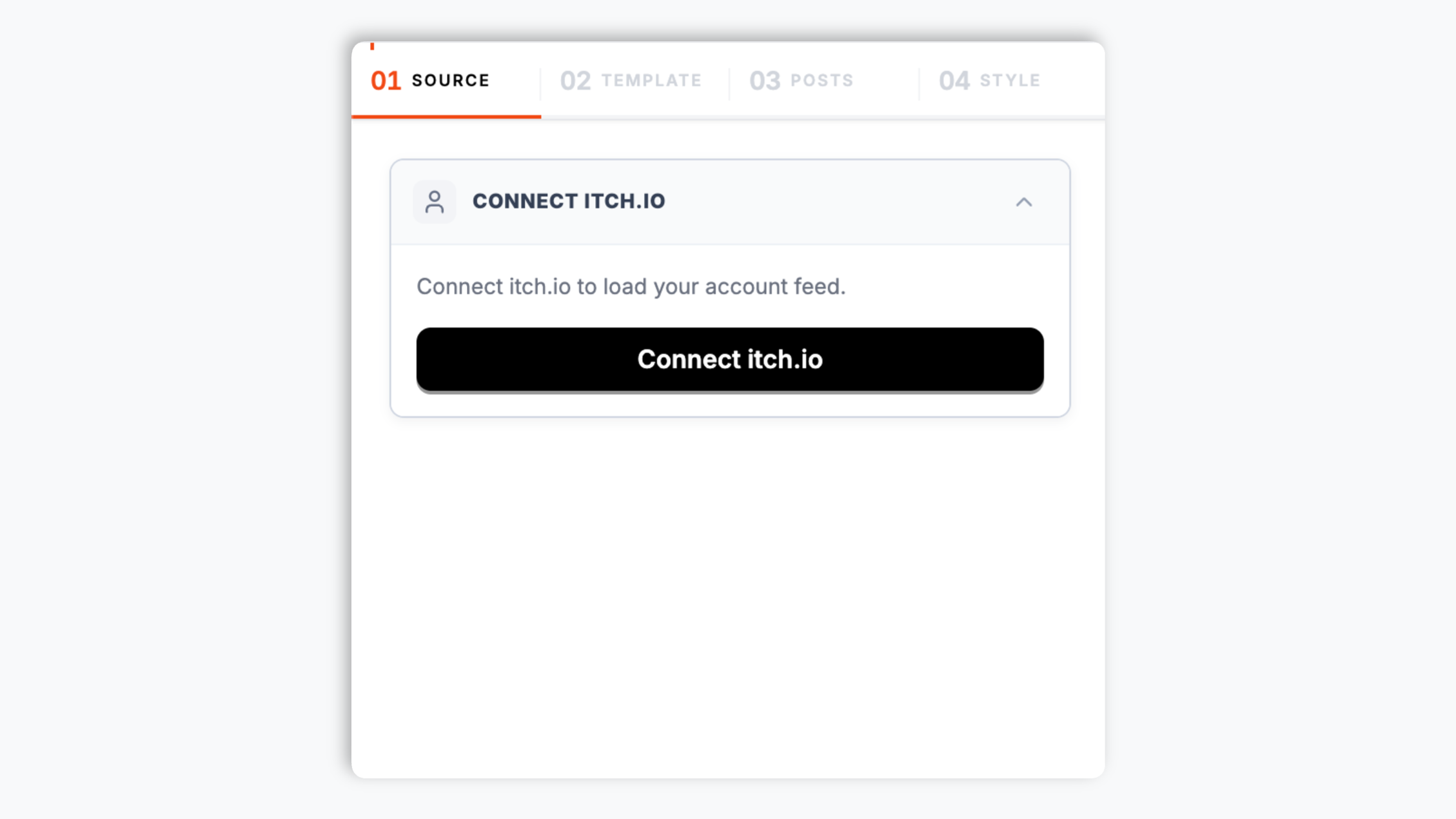
    Poper widget builder showing the itch.io creator search input with AcmeJam autocomplete to acmejam.itch.io, 47 jam entries, Featured badge and red itch.io Connect button
  2. 02

    Pick a layout and pin your flagship

    Choose Catalog grid, Jam portfolio, Tools shelf, Devlog rail or Zine wall. Pin a flagship project, filter by jam, and tweak colors to match your dev brand.
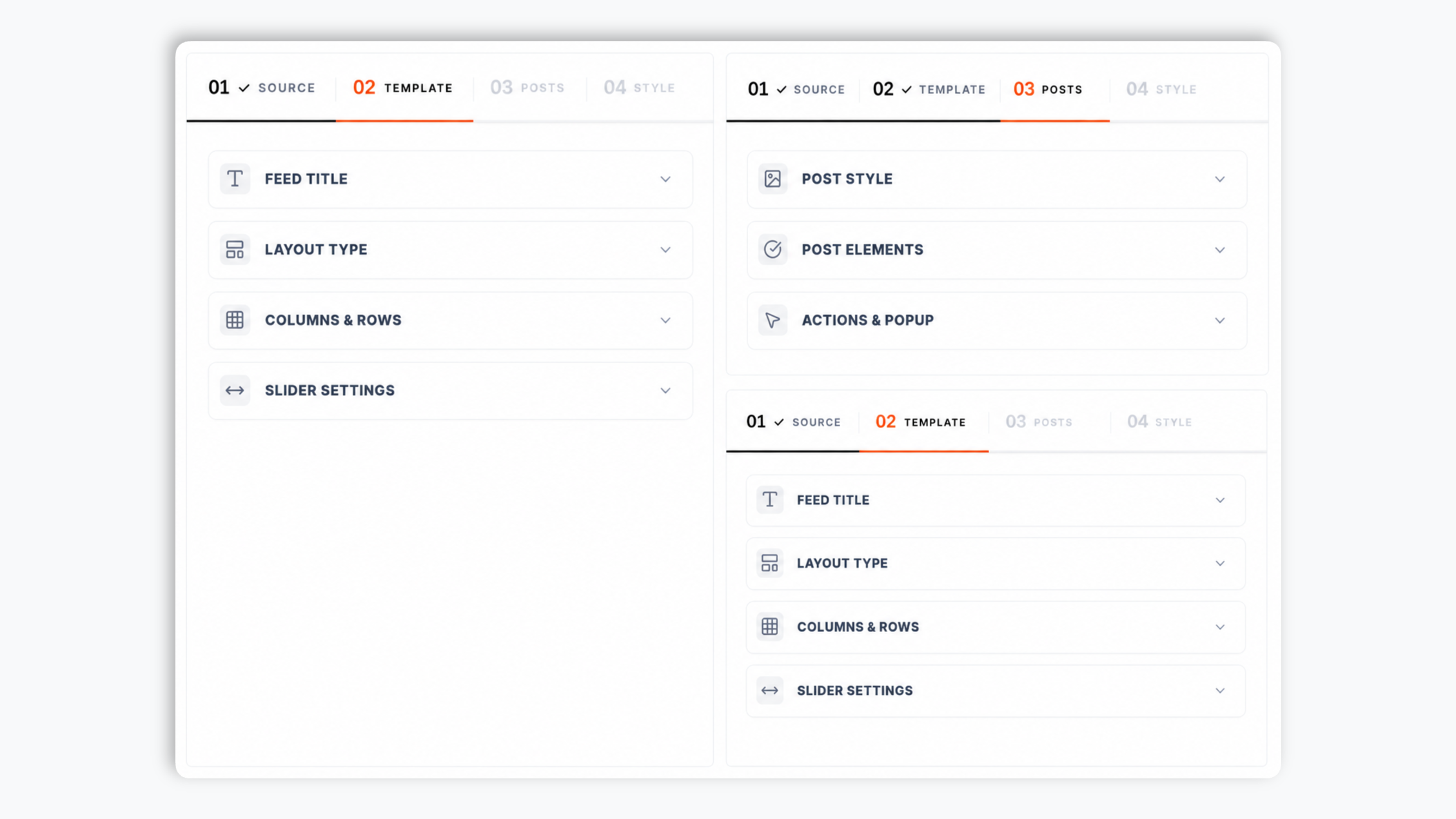
    Six layout thumbnails for the itch.io feed widget (Game-card, Jam grid, Featured, Devlog rail, Magazine, Wall) plus brand color picker and PWYW + jam-rank chip controls
  3. 03

    Copy the snippet and embed

    Paste the one-line script tag onto your dev portfolio, jam recap page, or studio site. Works on WordPress, Ghost, Carrd, Webflow, Framer and 250+ platforms.
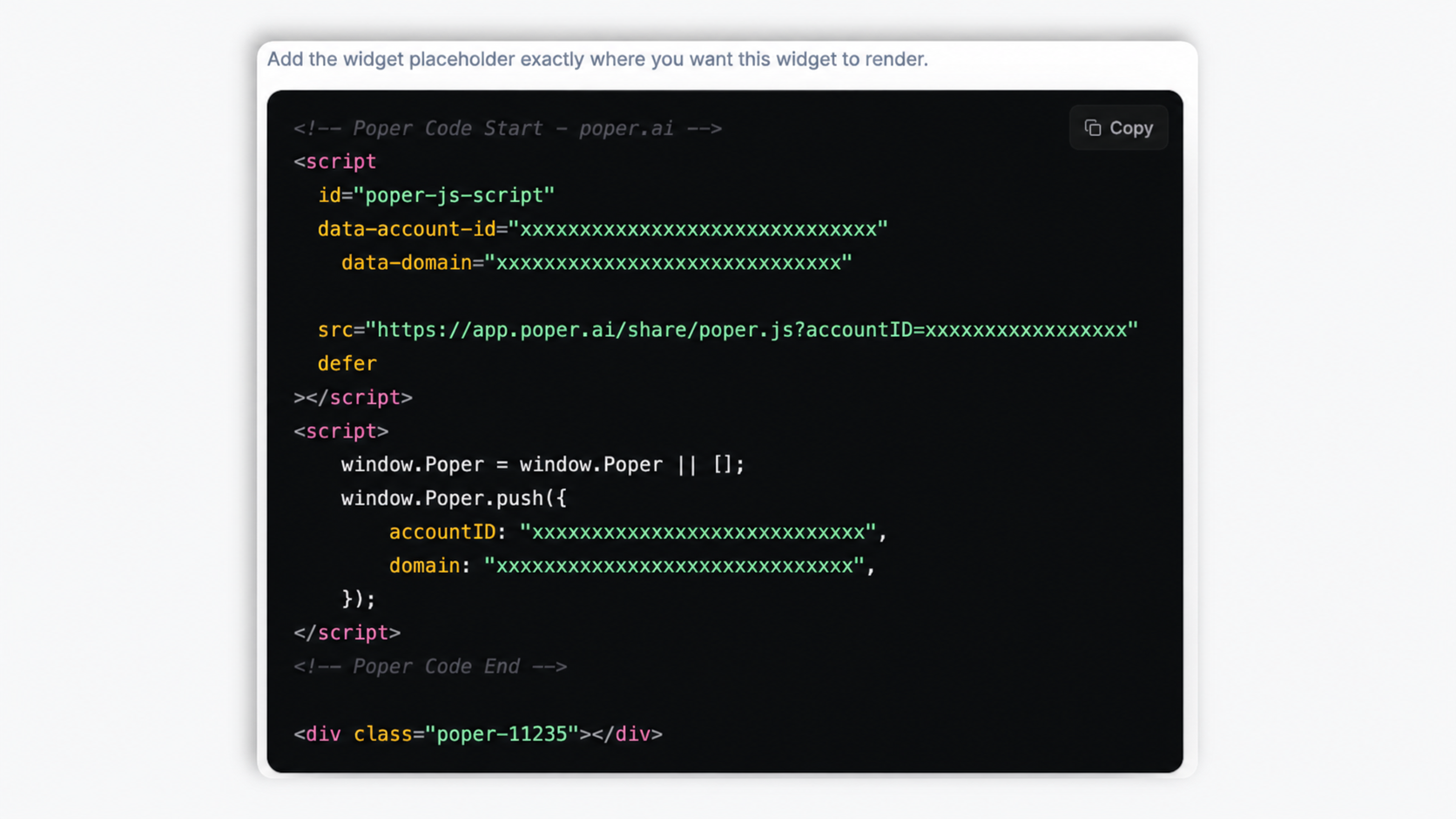
    One-line embed script tag for the itch.io feed widget shown in a code editor with itch.io red Copy button and Webflow, Framer, Carrd, GameJolt, and Steam platform badges

Works everywhere

Works with every website platform you already use

Drop-in install on WordPress, Shopify, Wix, Squarespace, Webflow, Framer, Ghost, and any HTML-friendly stack. No build step, no developer needed.

WordPress
Shopify
Wix
Squarespace
Webflow
Framer
Ghost
HTML

Plus 250+ other platforms via the embed snippet. If your site can render a <script> tag, it can render the itch.io Feed Widget: Embed Your Indie Catalog, Devlogs, Game Jams and PWYW Tools.

What you get with the Poper itch.io Feed Widget

Six things that matter when you are mirroring an indie catalog, not 30 features no one uses.

Pay-what-you-want, treated as a first-class price model

Every other store widget treats price as a number. itch.io creators ship PWYW with a suggested minimum, charity bundle pricing, and 0-floor downloads. Poper renders the actual PWYW chip with the suggested minimum and any charity split intact, so visitors see the real terms instead of a misleading $0 or hidden total. The way itch.io actually works.

Game jam filtering and ranking display

Filter your catalog to a single jam (Ludum Dare 55, GMTK 2026, Global Game Jam 2026) and surface the placement and rating from itch.io directly on the card. Built for jam dev portfolios.

Multi-creator aggregation

Combine 2 or more itch.io creator pages into one feed. Built for studios, collectives, and jam teams who ship under multiple handles.

Devlog rail

Pull devlog posts into a secondary rail under each project so visitors see the heartbeat of your work, not just the static catalog.

Core Web Vitals safe

Lazy-loaded below the fold, async-injected, scoped CSS, under 40KB gzipped. Cover art served from a global CDN. No CLS, no LCP regression, no Lighthouse hit on your indie portfolio.

Project-type and platform-aware cards

Game, Tool, Asset, Comic, Zine, Soundtrack and Physical Game render with the right metadata. Platform badges (Windows, macOS, Linux, Web-playable, Android, iOS) tell visitors at a glance whether they can play in browser or need a download.

Indie-ethos by design

itch.io was built in 2013 by Leaf Corcoran and runs on a roughly 90% revenue share to creators, with the other 10% chosen by the creator (you can set it to 0 if you want). Poper does not push aggressive upsells, does not paywall basic catalog views, and does not surface ads inside your widget. Your indie page stays your indie page.

Use cases

Where itch.io Feed Widget: Embed Your Indie Catalog, Devlogs, Game Jams and PWYW Tools actually moves the needle

Four buyer types who get the most lift from embedding itch.io Feed Widget: Embed Your Indie Catalog, Devlogs, Game Jams and PWYW Tools on their site.

GMTK Game Jam 2026 banner with 48-hour countdown timer, finished pixel-art game tile and a jam-results card showing Top 10% rank with per-category ratings for an indie jam entry

Game-jam entries

Solo and small-team game devs who ship both 48-hour jam games and longer commercial projects. Mirror your full itch.io catalog on a personal site so visitors see your shipping cadence, jam track record, and range without leaving your domain.

Abstract art-game scene with concentric geometric shapes and a minimal UI card titled A Quiet Room with a PWYW name-your-price tag, the kind of experimental work itch.io creators ship

Experimental games

Creators of art games, walking sims, single-screen weird games, and Bitsy projects whose work tends to live on itch.io because no other storefront supports the format. A widget that respects PWYW and project type lets your indie page feel as personal as the work.

Bound TTRPG zine titled Quiet Storm with a d20 polyhedral die, two scattered six-sided dice, a hand-drawn character sheet and an ink-drawn map of the realm, the indie tabletop work itch.io zine makers publish

Tabletop RPG zines

Tabletop RPG designers, narrative zine makers, and comic creators using itch.io to ship PDFs and printable physical games. Surface your zine and TTRPG catalog with cover art, page count, and PWYW pricing intact.

Pixel-art tile sheet with grass, brick, water, sand and stone tiles, a 64-frame sprite collection on dark background, and an Indie Asset Mega Bundle cover card showing 42 packs at PWYW $15 with ~90% to creators

Art + asset bundles

Pixel artists, sprite-pack makers and asset creators selling tilesets, sprites, SFX libraries and bundle-cover art. Surface your full asset catalog with PWYW pricing and cover art intact for the indie devs who build with your work.

Poper vs other indie catalog widgets

itch.io has a free native embed, but it is one project at a time. Here is how the catalog-level options stack up.

 Recommended
Poper
itch.io native embed
Game Jolt widget
Steam widget
Free plan available
Limited
Whole creator catalog (not single project)
Pay-what-you-want price chip with suggested min
Per-project only
N/A
Game jam filtering and ranking display
Devlog rail under each project
Multi-creator combined feed
Project-type filters (Game, Tool, Asset, Zine)
Games only
Games only
Platform badges per card
Sync frequency (lowest plan)
6 hours
Live iframe
24 hours
24 hours
Custom CSS / total design control
Limited
Paid only
Bundled with popups, forms, quizzes
Pricing for unlimited projects
$19/mo (Starter)
Free
Free
Free

Comparison reflects publicly listed pricing and features as of 2026. Verify current details on each provider's site.

Indie creators shipping on their own domain

Solo devs, jam creators, plugin authors and zine makers who switched from native single-project embeds to Poper.

Poper has improved our website's user engagement! Since integrating Poper's personalized popups, we've seen a dramatic surge in conversions and user interactions. The platform's intuitive design makes creating and customizing popups a breeze, even for those with minimal tech skills. What truly sets Poper apart are its…
Jayson Ang
Jayson Ang
Singapore Property Swapper · Singapore Property Swapper
Fantastic app and support team, they are very quick to help and provide a solution or improvement to their product. Highly recommended!
Alex
Alex
CEO · AH
Poper has been a total lifesaver for our agency! As a digital marketing agency, we’re always juggling a million things at once. Poper has been a real game-changer in terms of streamlining our workflow and keeping track of all our clients’ campaigns. The ability to track all our clients’ websites from one place is a…
Idris Basir
Idris Basir
-

Pricing

Simple pricing. Free plan covers most websites.

Free forever for one widget. Upgrade only when you need faster sync, multiple instances, or to drop the watermark.

Free

Everything you need to ship the widget today.

$0forever
  • 1 widget instance
  • All layouts & customization
  • Brand-match styling
  • 6-hour sync cadence
  • Poper watermark
Start free
Most popular

Pro

Remove the watermark, faster sync, more widget instances.

$19/mo
  • Unlimited widget instances
  • 30-minute sync cadence
  • No Poper watermark
  • Custom CSS
  • Priority email support
  • Shoppable tagging
Start 14-day trial

Business

Multi-site, multi-account, white-label.

$49/mo
  • Multi-account combined feeds
  • Real-time sync
  • White-label embed
  • API access
  • Dedicated success manager
  • Custom SLA
Start 14-day trial

All plans include unlimited page views, no contracts, cancel anytime. Annual billing saves 20%.

Guide · 7 min read

The complete guide to embedding your itch.io catalog on your website

itch.io is the open, indie-first storefront for games, tools, assets, comics, zines and soundtracks. It was founded in March 2013 by Leaf Corcoran as a side project, originally as a place to host his own work and the work of friends, and grew into the place where indie devs ship their first prototype, where seasoned indies run pay-what-you-want sales, where Bitsy and Pico-8 communities post their entire catalogs, where the experimental art-game scene actually lives in 2026, and where every major game jam (Ludum Dare, GMTK Game Jam, Global Game Jam, Brackeys Game Jam, Strawberry Jam) hosts submissions and rankings. The catch: itch.io is a marketplace with a house style, not your personal site, and the native embed only handles one project at a time as an iframe. If you ship more than a single project, or run multiple jams a year, or sell tools alongside games, or want devlogs to live next to releases on your own domain instead of behind a click on itch.io, you need a real catalog widget. This guide walks through what actually matters when you bring your itch.io catalog onto your own domain in 2026: the indie ethos baked into the storefront, the right way to render pay-what-you-want pricing, why jam culture deserves first-class filtering, why non-game project types (tools, assets, comics, zines, soundtracks) need their own card templates, and why widget performance is the difference between ranking on page 1 and ranking on page 4 for your own dev name.

01

Why itch.io is different (and why your widget should respect that)

itch.io was launched in March 2013 by Leaf Corcoran (working under the company name Tasty Pixel) with one stated goal: give creators a fair share of revenue and full control over how they sell. By default the platform sends roughly 90% of revenue to creators, and the remaining 10% platform cut is itself set by the creator. That last detail still surprises people. You can set the platform cut to 0%, and itch.io still ships your work. By comparison, Steam takes 30% (dropping to 25% past $10M and 20% past $50M). Apple's App Store takes up to 30%. Google Play takes 15 to 30%. Most asset stores take 30 to 50%. Patreon takes 5 to 12% plus payment processing. itch.io takes whatever you decide, and you can change that decision per project. The cultural consequence is huge: itch.io creators tend to ship weird, experimental, deeply personal work (art games, narrative zines, single-screen jam entries, queer dating sims, accessibility tools, Bitsy projects, niche dev plugins, tabletop RPG zines) that would not survive on bigger storefronts where curation is gatekept and minimum-price policies are enforced. A catalog widget that flattens itch.io into another marketplace grid misses the entire point of why creators chose to publish there in the first place. Poper renders PWYW chips honestly, surfaces devlogs as part of the work (not metadata), respects creator-set pricing including 0-floor downloads, and never injects ads or aggressive upsells into the embed. Your indie page stays your indie page.

02

Pay-what-you-want is a price model, not a discount

Most generic price widgets treat itch.io PWYW projects as $0 or as a confusing $0+ range, both of which misrepresent what creators are actually doing on the platform. PWYW on itch.io comes with a suggested minimum (the creator's signal of what feels fair, displayed prominently in the itch.io UI), an optional minimum floor (the smallest amount anyone can pay, often 0 for indie work but sometimes higher for tools or commercial assets), and an optional charity-split percentage that routes a share of every sale to a named cause. The Bundle for Racial Justice and Equality on itch.io in June 2020 is the canonical proof of how powerful this model can be. Organized by Vambleer and a coalition of indie creators, the bundle ran from June 5 to June 15, 2020, asked for a $5 minimum payment, included 1,741 items from over 800 creators, and raised more than $8.1 million for the NAACP Legal Defense Fund and the Community Bail Fund. Almost 200,000 people paid into the bundle. That bundle showed PWYW is not a discount mechanism, it is a community contract: the creator says 'this is what feels fair, pay what you can,' and the buyer says 'I am paying you, and the cause, and the platform that lets this exist.' Poper renders PWYW with the suggested minimum, the floor, any charity split, and the 'name your price' chip so visitors understand the actual terms before they click through to itch.io.

03

Game jam culture and the jam portfolio page

itch.io is the de facto home of game jams on the open web. Ludum Dare migrated its official hosting to itch.io and now runs jam submissions and rankings on the platform every quarter. GMTK Game Jam, organized by Mark Brown of Game Maker's Toolkit, draws 5,000+ entries per year hosted on itch.io and consistently ranks as one of the largest game jams in the world. Global Game Jam runs many of its site-level submissions through itch.io. Brackeys Game Jam, Pirate Software's GameJam, the Strawberry Jam, the Pico-8 Jam, the Bitsy Jam, the Cozy Autumn Jam, and dozens of smaller themed jams all live on the platform. For a jam-active dev, the catalog is not just 'games I made' but 'jams I shipped' (theme constraint, ranking, time pressure, team size, scope). Most generic catalog widgets cannot tell the difference between a 48-hour Ludum Dare entry and a 2-year commercial release, which is exactly the difference jam devs want surfaced when they show their work to recruiters, publishers, or collaborators. Poper supports jam filtering by jam slug (for example ludum-dare-55, gmtk-2026, brackeys-12) or by year, surfaces the placement and the per-category rating (Innovation, Theme, Mood, Audio, Graphics, Game Feel, etc.) from itch.io's jam ranking system on each card, and lets you build a dedicated 'Jam Portfolio' page that shows only your jam entries. Recruiters can see your shipping cadence and your jam track record at a glance, which is a much stronger signal than a static resume bullet point.

04

Project types beyond games (tools, assets, comics, zines, soundtracks)

itch.io is one of the only mainstream storefronts that treats non-game creative work as first-class catalog content. On the same creator page as your video games you can sell Godot plugins, Unity tools, Construct templates, GameMaker libraries, Bitsy templates, RPG Maker resources, pixel art packs, voxel asset packs, sound effect libraries, music loops, comics, narrative zines, tabletop RPG zines (the entire 'PbtA-adjacent zine' scene practically lives on itch.io), Lasers and Feelings hacks, board game prototypes, printable physical games (PDFs of card games, dice templates, paper prototypes), and even soundtracks ripped from your own jam entries. The catalog metadata exposes a project type field (Game, Tool, Asset, Comic, Zine, Soundtrack, Physical Game, Mod) and your widget should respect it instead of forcing every project into a single 'game card' template. Tools render with version, engine compatibility, and download size. Assets render with file format, license, and a usage example if provided. Comics and zines render with cover art and page count. Physical games render with print-and-play notes. Soundtracks render with track count and duration. Filtering by project type lets you build a 'Tools shelf' page targeted at gamedevs, a 'Zine catalog' page targeted at TTRPG players, or a 'Soundtracks' page targeted at composers, all off the same itch.io profile. That is exactly how indies on itch.io tend to organize their work in practice, and most third-party widgets do not support it at all.

05

Why widget performance still matters for indie portfolios

An itch.io catalog is heavy on cover art by definition. Indie game cover art on itch.io is often 1024x768 or larger (the platform's recommended cover dimensions are 630x500 minimum but 'larger is better' for retina displays), animated cover GIFs are common, and a busy creator might have 30 to 80 cover images in their catalog. Loaded naively, that is several megabytes of imagery on a single page and a tanked Lighthouse score on a personal portfolio that probably also runs analytics, an embedded YouTube trailer, a Discord widget, and a press-kit modal. Indie devs are not big-budget DTC brands with a Cloudflare engineer on staff. The portfolio is usually a Carrd page, a Ghost blog, or a Webflow site, and a slow widget can sink the whole page. Poper's itch.io widget loads asynchronously below the fold by default, fetches catalog data from a global CDN edge cache (your visitors do not hit itch.io on every page view, which is also kinder to itch.io's servers), lazy-loads cover art with proper width and height attributes to prevent layout shift, uses scoped CSS that will not collide with your portfolio CSS, ships zero blocking JS in the critical render path, respects prefers-reduced-motion for animated covers, and clocks in under 40KB gzipped. For a portfolio site that gets indexed by Google and shared in Discord servers and on Cohost, that performance gap is the difference between ranking on page 1 and ranking on page 4 for your own dev name. It is also the difference between visitors browsing your full catalog and visitors bouncing because the page froze on a 6-year-old laptop. Indie audiences play on whatever hardware they have, and your portfolio should respect that. The widget also defers cover-art animation until the card scrolls into view, which keeps battery and CPU usage low on phones and Chromebooks where a lot of indie game discovery actually happens in 2026.

Quick reference

What is itch.io Feed Widget: Embed Your Indie Catalog, Devlogs, Game Jams and PWYW Tools?

An itch.io feed widget is an embeddable script that mirrors a creator's itch.io catalog (games, tools, assets, comics, zines, soundtracks, devlogs and game jam entries) onto any website while keeping itch.io as the source of truth. It surfaces pay-what-you-want pricing, project type, platform badges, and jam rankings without requiring any code.

Key facts

  • itch.io was founded in 2013 by Leaf Corcoran as an indie-first storefront for games and creative tools.
  • itch.io sends roughly 90% of revenue to creators by default, and the remaining 10% platform cut is set by the creator (it can be set to 0%).
  • itch.io is the home of major game jams including Ludum Dare, GMTK Game Jam, Global Game Jam and Brackeys Game Jam.
  • Pay-what-you-want is a first-class price model on itch.io, with a suggested minimum, an optional floor, and optional charity-split pricing.
  • The June 2020 Bundle for Racial Justice and Equality on itch.io raised over $8 million for the NAACP Legal Defense Fund and Community Bail Fund with 800,000+ creators contributing 1,700+ items.
  • itch.io exposes every public creator page as RSS at yourname.itch.io/feed.xml plus structured catalog metadata, so widgets can render the catalog without an API key.

Frequently asked questions

Can't find the answer you're looking for? Chat with our support team.

Contact Support

Mirror your itch.io catalog in under 2 minutes

Free plan forever. Games, tools, devlogs, jams, zines, all in one live catalog on your own domain.

Free plan available forever