





















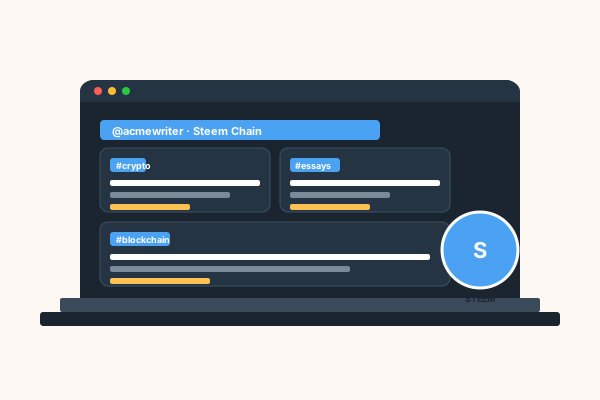
The complete guide to embedding Steemit blockchain posts on your website
A steemit feed widget is how you turn a decade of blockchain-native blogging into website content without breaking the on-chain reward economy that Steem authors have relied on since 2016. Steem launched on March 24, 2016 as the first Delegated Proof of Stake social blockchain, designed by Daniel Larimer (BitShares, later EOS) and Ned Scott to make every post, comment, upvote, and reward payout a permanent chain operation. For nearly four years it was the canonical example of crypto-incentivized publishing, paying out tens of millions of dollars in STEEM and SBD rewards to authors who would otherwise have written for free on Medium or Wordpress. Then in February 2020 Justin Sun (Tron founder) acquired Steemit Inc., the company that ran the steemit.com front-end and held a substantial pre-mined stake originally intended for ecosystem development. The acquisition triggered an immediate governance dispute, and within weeks the bulk of the active authoring community organized a coordinated chain split: Hive forked from Steem on March 20, 2020, redistributing the original stake to community members rather than leaving it under a single corporate holder. Most active users moved to Hive. The Steem chain itself, however, continues to operate in 2026 under Justin Sun's stewardship. Block production has continued without interruption, the full 2016-through-2020 archive remains permanently committed to chain, and a smaller residual community still publishes new posts. For embedding purposes Steem is the right tool when you specifically want the pre-fork archive, the legacy STEEM holder community, or the original chain itself rather than the community that left. This guide is honest about that positioning: it walks through what actually matters when you choose and configure a Steemit widget in 2026, including the steemd RPC layer, the Justin Sun era and what changed (and what did not), the STEEM and SBD reward curve and how to preserve it, the comparison against Hive for creators choosing where to publish today, and why Article and BlogPosting Schema.org markup matters even more for blockchain content than for centralized publications.
04
Schema.org Article and BlogPosting: the SEO leverage centralized platforms ignore for blockchain content
Embedding posts and ranking posts are two completely different things. A bare list of post titles linking to steemit.com is invisible to Google's understanding of the underlying content because Google cannot effectively crawl what is inside an iframe and rarely executes the JavaScript needed to follow chain links. To be eligible for rich results, for the related-articles carousel that appears on long queries, and to get the byline plus publish date next to your organic listing, your page needs Schema.org Article or BlogPosting structured data for each post. Required fields include headline, datePublished (ISO 8601), author (with name and profile URL), and image. Strongly recommended fields include description, dateModified, publisher, and articleBody for full text indexing. Centralized blogging platforms like Medium hand you minimal structured data on the post page itself, and almost no third-party widget that aggregates posts emits structured data for the embedded set. Steemit.com emits structured data on its own canonical post pages, but the structured data does not propagate when the post is embedded elsewhere. Poper auto-injects a complete Article or BlogPosting JSON-LD block for every Steem post in the feed, populated from chain post metadata (title, body, tags, author handle, creation timestamp from the chain) plus reputation-weighted publisher attribution. The result is that a page with the Poper Steemit widget embedded ships richer structured data than the steemit.com watch page itself for the embedded subset, because conventional embed providers do not emit structured data at all. Validate after embedding by pasting your page URL into Google's Rich Results Test. This is the single highest-leverage SEO move available to any Steem author publishing on the open web in 2026: your blockchain-committed content becomes discoverable in conventional search alongside centralized blog content, while still living on a censorship-resistant chain that has been operating continuously since March 2016.